Dr Sandra Pertek is an interdisciplinary senior researcher and social development practitioner with over a decade of practical and policy experience in international development.
Inspired by social justice, urged by global challenges of displacement.
Scroll down
Latest Projects
Making aid work for displaced women: Integrating Islamic philanthropy and the international humanitarian system
Integrated intersectional and socioecological approach: Engaging with religion to strengthen protection from violence against women in forced displacement
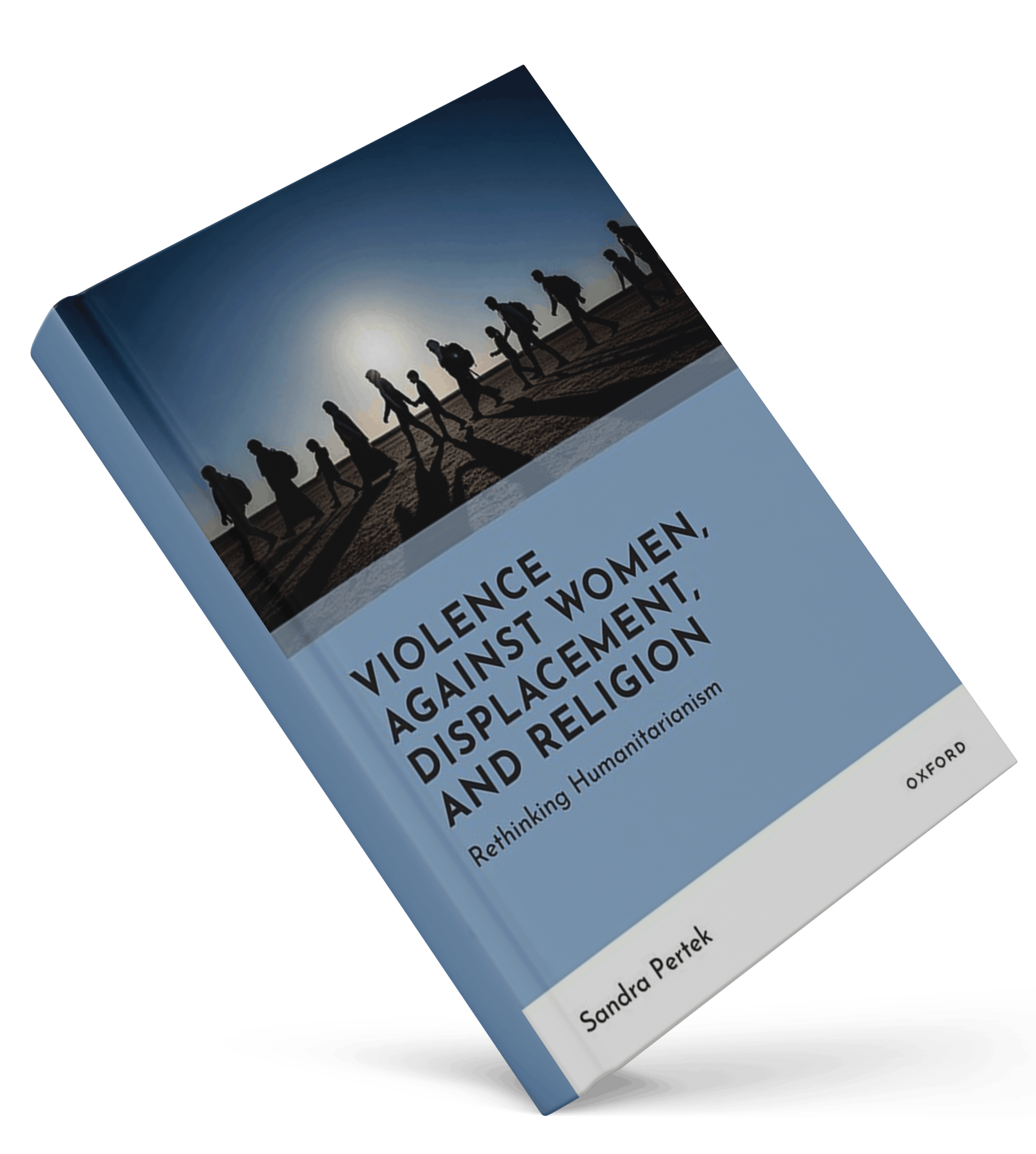
Violence Against Women, Displacement, and Religion: Rethinking Humanitarianism
Abstract: Violence against women, displacement and religion: rethinking humanitarianism explores religious influences in displaced women’s experiences of violence by developing and applying a novel integrated intersectional and socioecological analysis. Drawing on empirical mixed‑methods research with humanitarian practitioners, and Christian and Muslim African and Levantine displaced women in Türkiye and Tunisia, the book reveals religion evolves as both a source of an intersectional vulnerability and a resource for resilience, coping and displacement. The reader visits the survivors’ intimate relations with the sacred and their meanings of religious constructs. The book argues that religion is an integral part of survivors’ experiences, which are rarely understood by dominant humanitarian frameworks that secularise women’s realities and frequently overlook their spiritual suffering. By bridging humanitarian, migration and religious ecosystems, the volume proposes the development of an ‘intersectional ecology of protection’. This volume bridges a gap in knowledge on the dual role of religion in a spiralling continuum of violence across forced migration routes, thereby expanding the scholarship of gender, religion, displacement and humanitarianism. It contributes to the humanitarian reform debates by challenging disengaged approaches to religion in policy and practice, and so it advances more inclusive approaches to protection in ways where lived experiences of religion are understood.